
24 Aug From Tree to Table: The Ancient Olive Groves of Puglia
In Puglia, olive oil isn’t just something you cook with — it’s part of the landscape. Drive almost anywhere in this southern region of Italy and you’ll see them: rows of silvery-green trees stretching to the horizon, their twisted trunks shaped by centuries of wind and sun. Some stand in neat commercial groves, others in small family plots, and a few are so ancient they have seen empires come and go.
For the Pugliese, olive oil is more than a product. It flavours their meals, anchors their traditions, and, in many cases, provides a small but steady income. Spend a little time here and it quickly becomes clear: the olive tree is as much a part of Puglia’s identity as its whitewashed towns and its sunny Adriatic coast.
The Roots of a Tradition
Puglia’s relationship with the olive tree goes back thousands of years. The Greeks and later the Romans cultivated olives here, spreading groves across the region and turning olive oil into one of the Mediterranean’s most valuable commodities. It was used not only in kitchens but also for lighting lamps, making soaps, and in religious rituals.
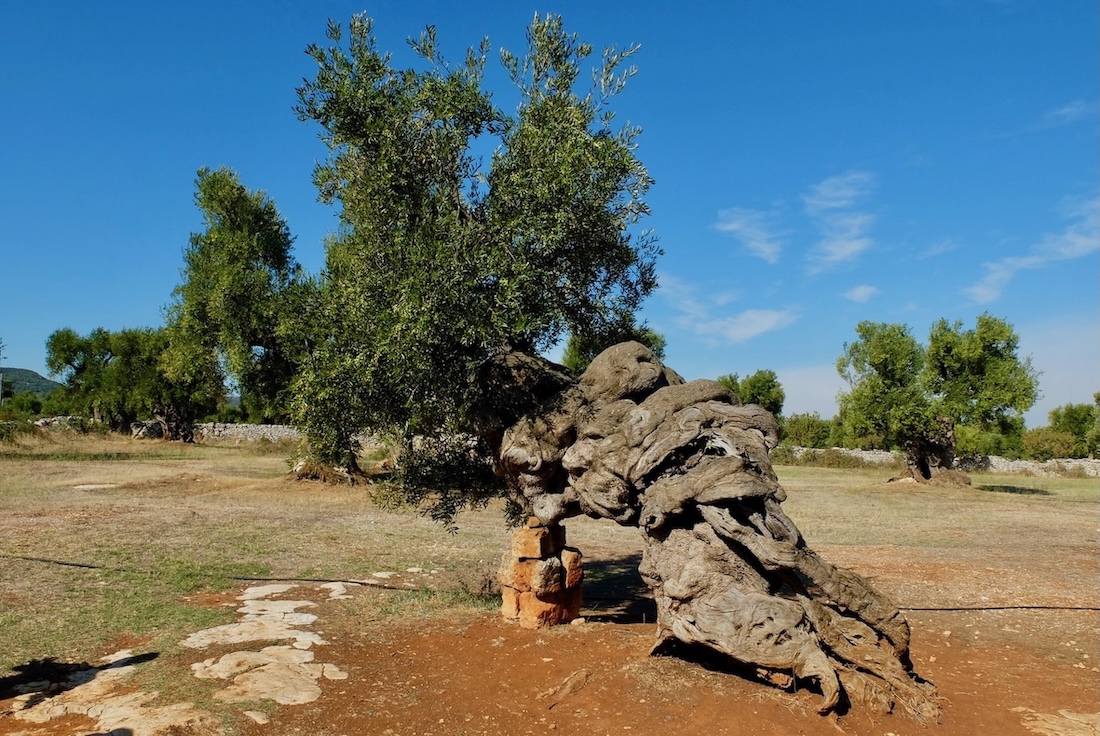
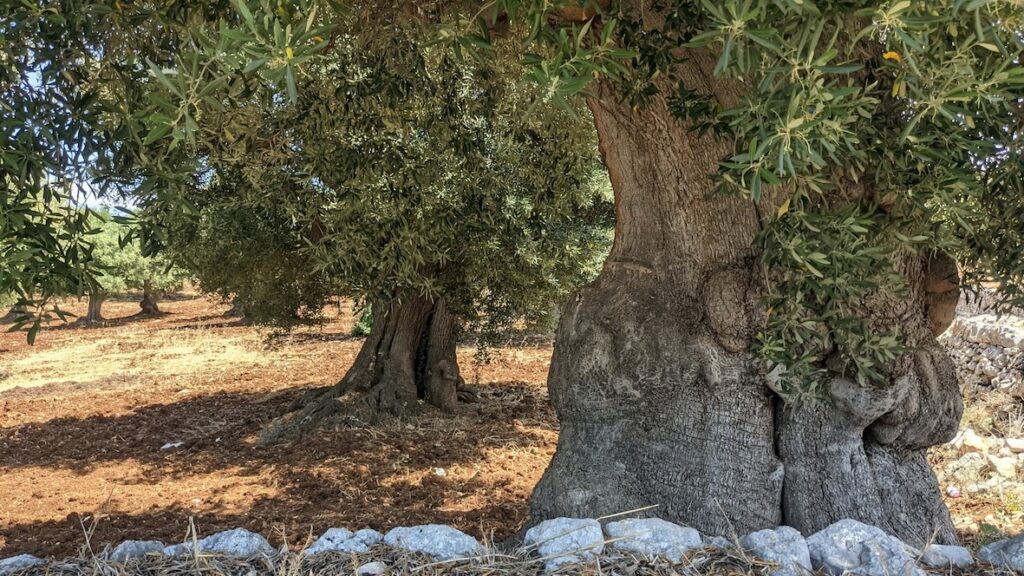
Some of those early groves survive to this day. Many of the region’s trees are over a thousand years old, their thick, gnarled trunks twisting and splitting into sculptural forms shaped by weather and regrowth. A few are so large that it takes several people holding hands to circle their base. Walking among them is like stepping into living history.
Today, Puglia is Italy’s largest olive oil producer, responsible for around 40% of the national output. What makes it special, though, is that production is still rooted in countless small growers, each tending their own patch of land.
The Land and Its Oil
The quality of Puglia’s olive oil begins with its environment. Long, hot summers and mild winters make for ideal growing conditions. The limestone-rich soil drains quickly, forcing roots to dig deep and strengthening the trees. The salty breezes from the Adriatic and Ionian seas add their own subtle influence.
Two of the most important local varieties are Ogliarola and Coratina. Ogliarola produces a mild, fruity oil with a touch of sweetness, perfect with fish, vegetables, and salads. Coratina is the opposite: bold, peppery, and lingering, a robust oil that shines drizzled over hearty dishes or fresh bread. Many producers blend these and other varieties to balance flavour and complexity.
For visitors, tasting oil fresh from the press is often a revelation. A good extra virgin olive oil has a brightness and depth that supermarket bottles rarely capture. Depending on the harvest, you might taste grassy notes, hints of tomato leaf, or that distinctive peppery kick known as the “Puglian tickle.” When you taste it here, surrounded by the groves themselves, it’s easy to understand why olive oil has been central to life in this region for millennia.
Ancient Meets Modern
Harvest season, from late October to December, remains one of the most critical times of year. Families and friends gather in the groves, spreading nets beneath the trees and gently combing olives from the branches with small rakes. It is hard work, but it still carries the sense of tradition and community that has always surrounded the olive harvest.
Pressing methods have changed more dramatically. In the past, olives were crushed with heavy stone wheels, and many old presses still survive as reminders of that history. Today, most producers use modern stainless-steel machinery, where cold pressing at controlled temperatures helps preserve flavour and quality.
One of the best places to see this blend of old and new is at Masseria Brancati, just outside Ostuni. This family-run farm has been producing olive oil for generations. It even contains archaeological remains from Roman times, including an underground press carved from the rock. Some of its monumental olive trees, carbon-dated at more than 3,000 years old, still produce fruit today. Standing among them, you can’t help but feel a sense of continuity — these same trees were yielding olives when the Roman Empire was at its height.
The family now manages the estate with a mix of traditional knowledge and modern organic practices, producing award-winning oils while safeguarding their historic grove. For many visitors, a walk through these ancient trees and a taste of their oil becomes one of the most memorable parts of a journey through Puglia.
Olive Oil in Everyday Life
While estates like Masseria Brancati operate on a larger scale, olive oil in Puglia is still deeply personal. Almost everyone has a few trees, passed down through generations or planted as a way of keeping a connection to the land. The oil from these small groves may never reach the market, but it supplies households, neighbours, and friends.
Our good friend Matteo — who also drives our groups around Puglia — is one example. At home on the Gargano Peninsula, he tends his family’s grove and each autumn, after the harvest, he presses the olives and bottles the oil. He also sends some north to Friuli, where Luca’s mother and her friends wait keenly for their supply each year.
Bringing a Piece of Puglia Home
When you travel in Puglia, you don’t just taste olive oil — you experience the whole story behind it. You meet the people who care for the trees, walk through groves that predate recorded history, and discover the flavours that come from this unique land. Taking a bottle home is more than a souvenir; it’s a way of carrying that experience with you.
Drizzle it over salad or focaccia back home, and the taste brings you back to sunny days among ancient olive trees. And when the bottle finally runs out, it may well be time to plan the next trip.
Come and explore the olive groves on one of our fabulous 2026 tours to Puglia!