Uncategorized

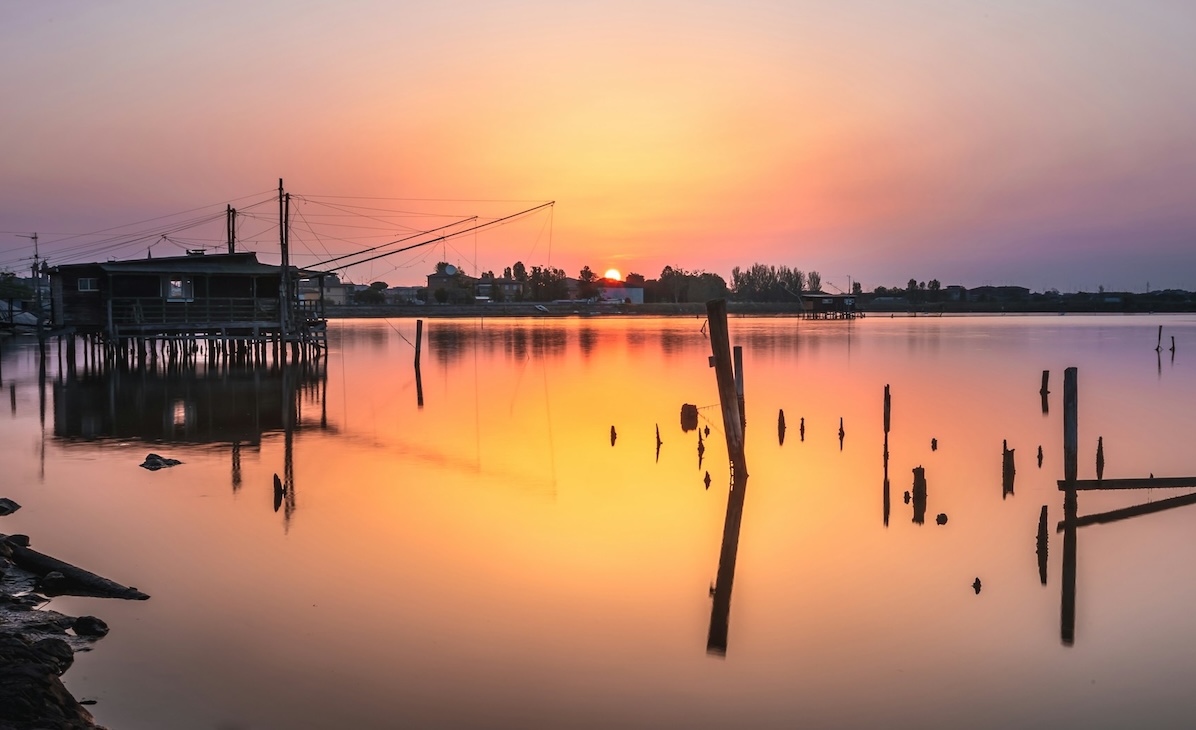
Traditional fishing huts and wooden posts reflected in the Po Delta wetlands at sunset, with warm orange and pink light over the lagoon

11 Dec Comacchio and the Po Delta: Discovering Emilia-Romagna’s Quiet Lagoon Town

Comacchio and the Po Delta: Discovering Emilia-Romagna’s Quiet Lagoon Town

Italy is celebrated for its famous cities, yet some of its most memorable places are the quieter ones where everyday life moves at its own pace. Comacchio, a small lagoon town in Emilia-Romagna, is one of these rare spots. Spread across thirteen low islands and shaped by canals and graceful brick bridges, it’s often compared to Venice, though it has a character entirely its own. Just beyond the town lies the Po Delta, one of Europe’s most significant wetland landscapes and a fascinating contrast to the region’s better-known highlights.

A Lagoon Town Shaped by Water

Comacchio is located just north of Ravenna and has been linked to its lagoon for centuries. Its relative isolation helped preserve the historic centre’s character: long stretches of water, quiet lanes with no cars, and a deep sense of calm as you walk from bridge to bridge.

The town’s most recognisable landmark is the Trepponti, built in the 1630s as a fortified gateway to the lagoon. With its staircases, brick arches, and view of the canals, it remains the natural starting point for any visit. From here, a gentle wander leads you along the Canale Maggiore, past Palazzo Bellini, and across the Ponte degli Sbirri beside the old fish market. Comacchio’s centre is compact and easy to explore at a relaxed pace, making it ideal for travellers seeking an authentic slice of Emilia-Romagna.
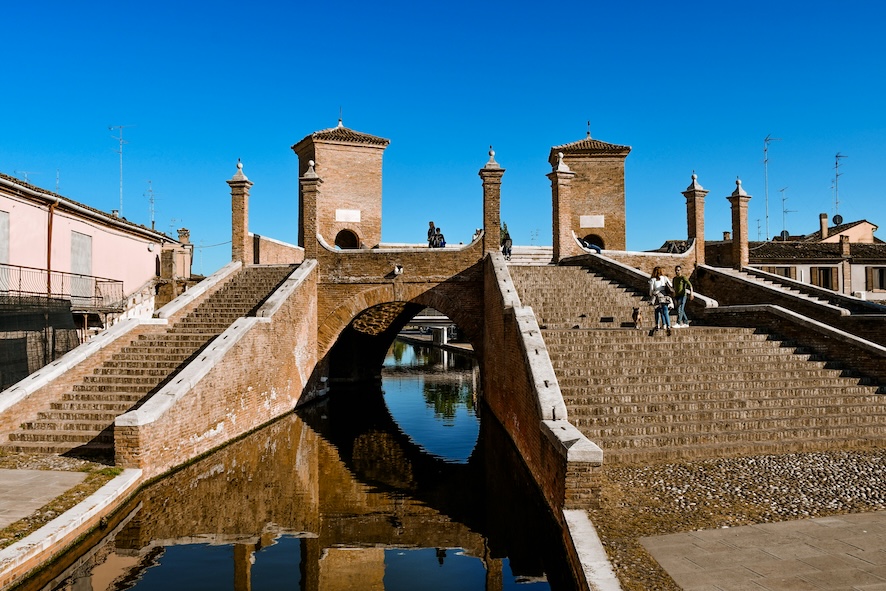
The Trepponti bridge in Comacchio, with its brick staircases, towers and arches reflected in the canal under a clear blue sky

Exploring the Po Delta: A UNESCO Wetland Landscape

Just outside the town lies the Valli di Comacchio, part of the wider Po Delta Park and recognised as a UNESCO World Heritage site. The Po Delta is one of the most important wetland environments in Europe: wide open skies, strips of land dividing shallow waters, and an extraordinary range of birdlife.

Pink flamingos are the highlight for many visitors. They gather in impressive numbers across the lagoons, a striking sight in any season. The wetlands also support herons, egrets, stilts and a variety of migratory birds, making this one of the best birdwatching destinations in Italy. The colours change throughout the year too, from the deep red of autumn glasswort to the pale pinks of tamarisk lining the water channels.

Scattered around the delta are the casoni, traditional fishermen’s huts built from wood and reeds. These simple structures recall a time when fishermen spent long months in the lagoon catching the prized local eel. They offer a window into a way of life that shaped the culture of Comacchio for generations.

Local Food and Traditions

Eel has long been at the heart of Comacchio’s identity. It’s still prepared in traditional ways – grilled, marinated or slowly cooked in broth – and features prominently in local dishes. For travellers unsure about eel, the wider region offers plenty of alternatives from the Adriatic: clams, prawns, and bluefish, often served simply and paired with Vini delle Sabbie, wines grown in the sandy coastal soils.

This connection between land, water and tradition is part of what makes Comacchio such a compelling place to visit. It offers a quieter, more genuine perspective on life in Emilia-Romagna.

Exploring Comacchio with Italian Tours

As part of our Unexpected Riches: Emilia-Romagna Tour 2026, we spend a full day exploring this beautiful corner of the region. After a gentle walk through Comacchio, we board a small private vessel accompanied by a local guide who knows the waterways well. Travelling in a smaller boat means we can navigate the narrow channels and get closer to the landscape and birdlife without disturbing the calm of the lagoon. We finish the morning with a traditional lunch, enjoying the dishes that have defined this area for centuries.

If you’re interested in discovering the lesser-known side of Emilia-Romagna – and experiencing Comacchio and the Po Delta with a knowledgeable local guide – you may like to take a look at our 2026 journey.
Read More
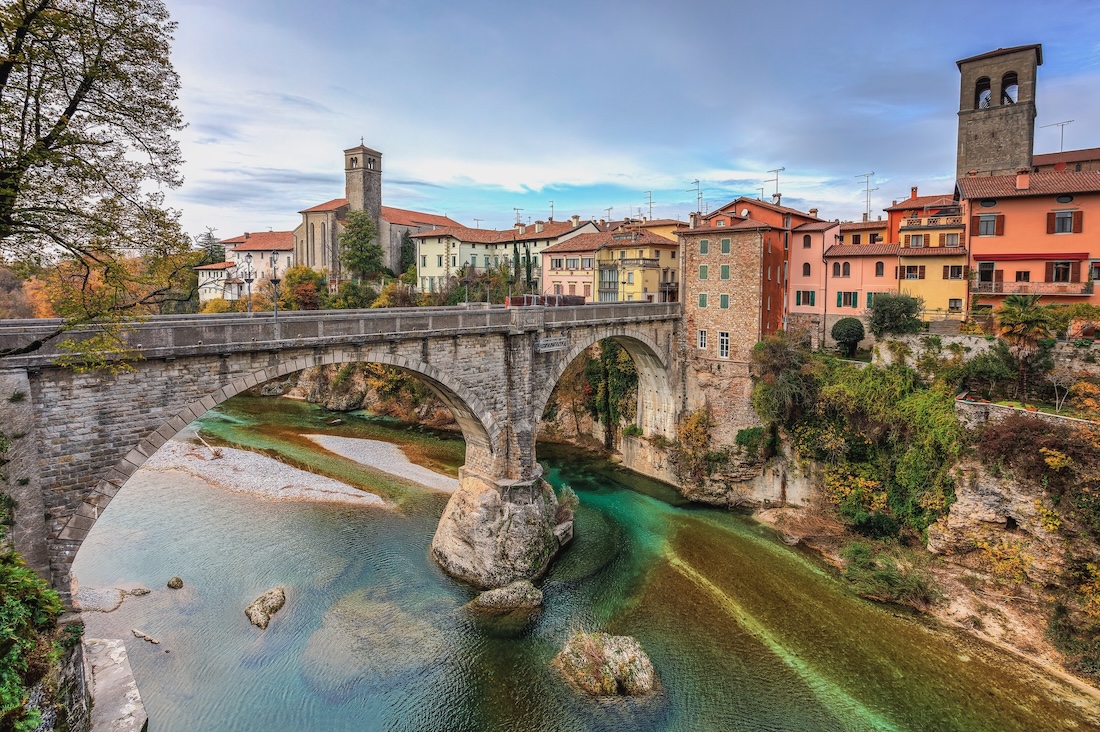
Historic stone Devil’s Bridge in Cividale del Friuli crossing the clear Natisone River with medieval buildings behind it.

02 Dec Why Friuli Venezia Giulia Is Italy’s Best Kept Secret – Clone

Why Friuli Venezia Giulia Is Italy’s Best Kept Secret


A Region of Remarkable Landscapes

Tucked away in the far north east of Italy, where the Alps ease into gentle plains and finally the Adriatic Sea, Friuli Venezia Giulia is one of the country’s most overlooked regions. Its landscapes are unusually varied. The foothills north of Sacile offer peaceful hilltowns, chestnut woods and turquoise lakes such as Barcis and Cavazzo. Higher up, the Julian Alps show a more alpine character, with wooden chalets, meadows and the beautiful ridgeline around Monte Lussari.

A short drive south takes you to a completely different setting of wide lagoons, sandy beaches and coastal towns shaped by centuries of Venetian influence.

History Written Across the Centuries

Friuli’s history stretches from ancient Rome to the medieval Longobards and through the eras of Venice and the Habsburg Empire. Aquileia was once one of the most important cities of the Roman world and today preserves a remarkable fourth-century mosaic floor, one of the most impressive in Europe.

Cividale del Friuli, founded by Julius Caesar, later became the capital of the Longobard Duchy and is home to the Tempietto Longobardo, considered a masterpiece of early medieval architecture. Across the plains, towns such as Portogruaro and Sacile still show their Venetian heritage in arcaded streets and elegant waterside villas. Further east, Gorizia and Trieste reflect their long connection with the Habsburgs and have a distinctive Mitteleuropean feel.

A Food and Wine Culture Worth Travelling For

Food and wine are central to life in Friuli. The Collio hills produce some of Italy’s best cool-climate wines, including Friulano, Ribolla Gialla and the red Refosco. Vineyards sit in neat terraces, and tastings often feel more like relaxed conversations than formal appointments.

In the mountains, the Montasio Plateau is known for its DOP cheese, produced in small alpine dairies. Prosciutto di San Daniele, rustic soups, handmade pastas and fresh seafood from the coast round out a cuisine that is simple, seasonal and firmly tied to the region.

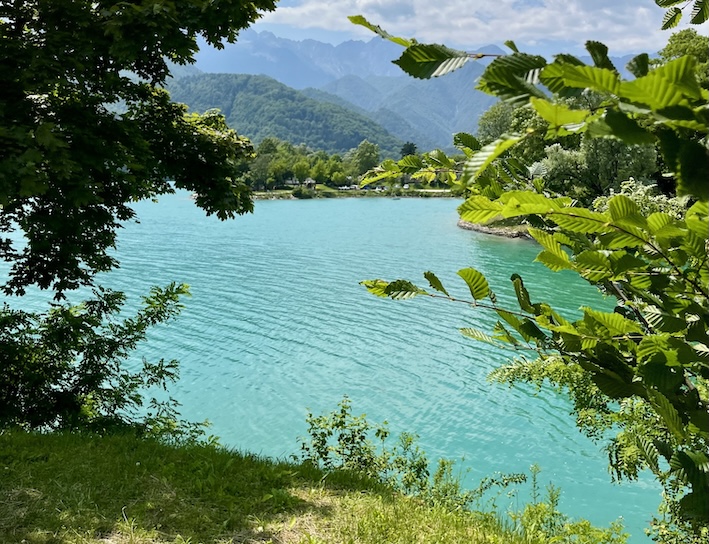
Turquoise waters of Lake Barcis framed by green trees and mountain peaks in Friuli Venezia Giulia.

The turquoise waters of Lake Barcis in the foothills north of Sacile.

Authentic Italy at a Relaxed Pace

One of Friuli’s great attractions is its authenticity. This is a part of Italy where life moves at a quieter rhythm, well away from the major tourist routes. Mornings are spent in small piazzas, afternoons wandering medieval lanes or walking by the lakes, and evenings enjoying good local food and a glass of wine. It suits travellers who prefer smaller towns, gentle walks and meaningful cultural experiences rather than big crowds or hurried sightseeing.

The Ideal Time to Visit Friuli

September is one of the most appealing months to explore the region. Days are generally mild to warm, evenings are cool in the foothills, and the light is clear, ideal for sightseeing and spending time outdoors. Vineyards are in full harvest, the sea is still warm, and the mountains are especially inviting.

Explore Friuli with Us

If you’re drawn to a quieter, more authentic side of Italy, our new small-group tour of Friuli Venezia Giulia offers a relaxed way to experience its landscapes, history, food and culture. We’d be delighted to show you this remarkable region.

You can find all the details of our Friuli Venezia Giulia tour here


Read More

11 Oct Discovering Lecce

Whether you’re on one of our small group tours to Puglia or setting off on your own adventure, Lecce should be at the top of your must-visit list for this southern region.

Known as the “Florence of the South,” Lecce is an enchanting destination that beckons travellers seeking a taste of Italy’s rich history and unparalleled architecture. Nestled in the heart of Puglia, this captivating city is a hidden gem. 

The city’s history dates back to ancient times, with its roots in the Messapian civilisation. Over the centuries, it has been influenced by various cultures, which have left an indelible mark on the city’s architecture and cultural heritage.

Key Places to Visit

Lecce is renowned for its stunning Baroque architecture. The cityscape is adorned with intricate details and ornate facades. The distinctive Baroque style is characterised by the use of local golden sandstone, known as pietra leccese, which gives the buildings a warm, honey-coloured glow. As you stroll through the city’s winding streets, you’ll encounter these masterpieces at every turn.

The city centres on Piazza Sant’Oronzo, named after Saint Oronzo, the city’s patron saint. Piazza Sant’Oronzo is known for its Roman ruins, including a well-preserved Roman amphitheatre. The square also features a column with a statue of Saint Oronzo at the top and an elegant loggia that was an early town hall. 

The remarkably well-preserved Roman Amphitheatre is a testament to the city’s ancient history. Its construction dates back to the second century AD and the time of Emperor Hadrian’s rule. It was only discovered by accident in 1901 when workers were digging foundations for a new building.

Another iconic square, the city’s religious heart, is the Piazza del Duomo featuring the Duomo di Lecce. The cathedral itself is a stunning example of Lecce Baroque architecture with an elaborate façade adorned with sculptures and ornate decorations.

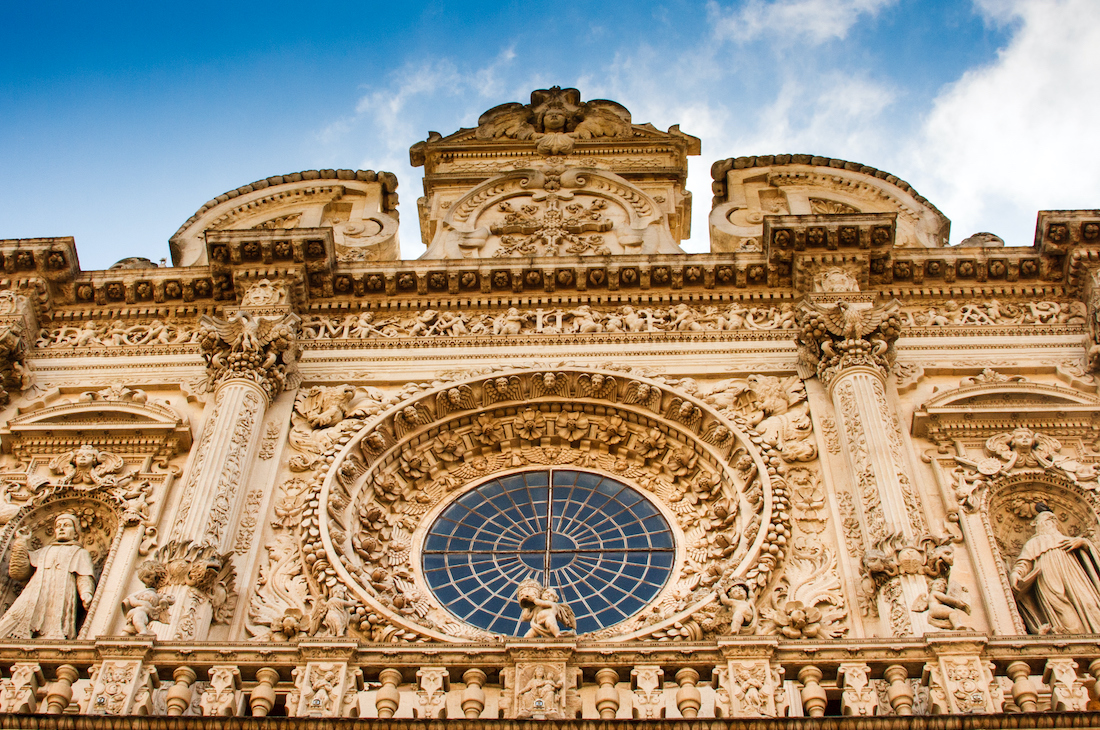
The Basilica di Santa Croce is perhaps the masterpiece of Lecce Baroque. The church is adorned with a façade featuring a rich abundance of statues, cherubs, and baroque designs.

Another prime example of Lecce’s architectural splendour is the Palazzo Celestine, a former monastery that now houses the City Hall. In 1807 during the Napoleonic occupation, the Celestine fathers were evicted, and the convent was put to other uses.

Not much remains of Lecce’s fortified walls, but the Porta Napoli still stands.  Completed in 1548 after a commission by Charles V to fortify the city, Porta Napoli is one of three entrances built into Lecce’s city walls. The entrance gate is a reminder of Lecce’s defensive past and offers an excellent photo opportunity.

Culinary Delights of Lecce and Salento

No trip to Lecce would be complete without savouring the region’s exquisite cuisine. Lecce and the surrounding Salento area have a distinct culinary identity, with several dishes that are unique to the region. 

Rustico Leccese

A popular snack or street food, Rustico Leccese is a savory pastry filled with tomato, mozzarella, and bechamel sauce. It’s often enjoyed as a quick, delicious bite.

Pasticciotto
This is a famous dessert from Lecce and Salento. Pasticciotto is a sweet pastry filled with creamy custard in various flavours, including classic vanilla and fruit variations.

Leccese Tarallini
These are small, crunchy, ring-shaped biscuits that make for an excellent snack or appetizer. They can be found in popular flavours, such as fennel or black pepper.

Melanzane Ripiene
Stuffed eggplants are a common dish in Lecce. The eggplants are typically hollowed out and filled with a mixture of breadcrumbs, cheese, herbs, and sometimes meat. They are then baked until golden and delicious.

Orecchiette con Cime di Rapa
While orecchiette pasta is not unique to Lecce, the way it’s prepared with cime di rapa (broccoli rabe or rapini) is a local speciality. The combination of the pasta’s shape and the slightly bitter greens creates a flavourful and beloved dish in the region.

Be sure to explore the local restaurants and trattorias to savour these delicious specialities during your visit to Lecce.

Exploring the Salento Area

Lecce’s strategic location makes it an ideal base for exploring the picturesque Salento region of Puglia. Nearby towns like Otranto and Galatina are easily accessible and offer unique cultural experiences, from historic churches to charming coastal landscapes.

Otranto
This coastal gem boasts a beautiful beach, a captivating historic centre, and the stunning Otranto Cathedral with its exquisite mosaic floor.

Galatina
Known for its impressive Basilica of Saint Catherine of Alexandria, Galatina offers a glimpse into Puglia’s religious heritage. Here, you can also visit the Pasticceria Ascalone, where Pasticiotto itself was invented in 1745.

Lands’ End
A short drive from Lecce will take you to Santa Maria di Leuca, where the Adriatic and Ionian Seas meet, marking the southernmost point in Puglia. The views here are nothing short of breathtaking.


You can stay in Lecce on our 14-day Road Less Travelled Tour of Puglia.

Read More